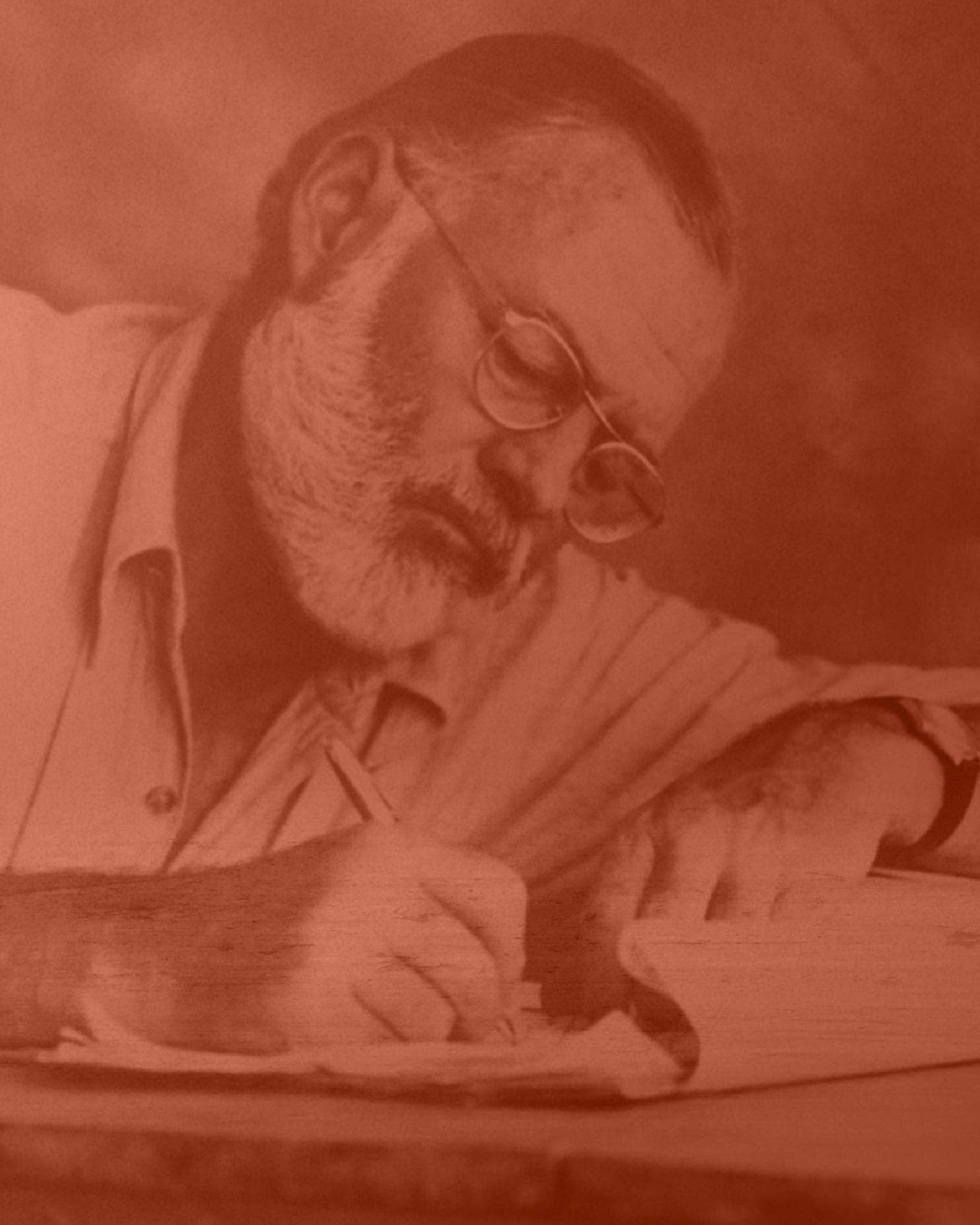
Simplicity as a guiding principle.
For Ernest Hemingway, writing was a way of being in the world. It was not about explaining reality, but about observing it closely and saying only what was necessary. His literature is born from observation, from direct experience, and from a deep trust in silence.
Every sentence in his work responds to a conscious choice. Nothing is accidental. The apparent simplicity of his style is the result of a demanding process in which precision replaces ornament and clarity becomes a form of depth. Hemingway understood that a well-placed word can sustain an entire emotion.
His well-known iceberg theory defines this way of writing: what is visible is only part of the story. His texts move forward through clean sentences, austere dialogue and a contained tension that trusts the reader’s intelligence—inviting them to participate, to fill in the gaps and to inhabit the text through their own experience. That relationship turns reading into something alive.
Ernest Hemingway’s characters face life with a tense serenity. There are no long speeches or unnecessary explanations. There are actions, gestures and decisions that reveal character. Courage, loss, the passage of time or dignity appear woven into the natural rhythm of the narrative.
The sea, the land, travel or waiting do not function merely as settings, but as part of the inner conflict. In this constant dialogue between human beings and their environment, Hemingway finds a simple truth: life is better understood when it is observed without filters.
His influence lies not only in what he wrote, but in how he wrote it. He taught us that strength can be sober, that emotion does not need explanation, and that clarity is a form of depth.
His work continues to remind us that simplicity, when it is honest, can be profoundly revolutionary. It remains relevant because it responds to an attitude: that of choosing what is essential and trusting that, when everything is in its place, nothing more is needed.
Related posts